The Institutional Repeat: The Endgame is Really The Springboard
THE ENGINEERED ENVIRONMENT
There comes a moment in every stability journey where you finally see it — the thing you’ve been feeling for years but couldn’t name:
The instability you’ve been fighting wasn’t personal. It was engineered.
Engineered through:
- rising costs
- shrinking margins
- unpredictable markets
- algorithm volatility
- donor inconsistency
- turnover
- burnout
- economic whiplash
And the worst part? You thought it was you. You thought you were disorganized. You thought you were behind. You thought you were inconsistent. You thought you were the problem.
But the truth is simpler and far more uncomfortable:
You are being squeezed by the same system that squeezes individuals — just at a higher altitude.
The pressure isn’t random. The chaos isn’t accidental. The overwhelm isn’t a coincidence.
It’s engineered.
And here’s the part that flips the entire environment on its head:
When YOU stabilize, you counter the engineering. Directly. Immediately. Permanently.
Because stability is the only thing the engineered environment cannot override.
THE PROOF: THE SHUTDOWNS NO ONE TALKS ABOUT
You can always tell when something is engineered by looking at who it breaks.
And lately? It’s breaking everyone.
Joann Fabrics — 790 stores closed A company with decades of brand equity and generational loyalty collapsed not because it was weak, but because the environment was designed to outpace its ability to adapt.
Party City — 700 stores gone A seasonal giant with predictable demand cycles still couldn’t outrun volatility. Their collapse wasn’t about balloons — it was about the system they were forced to operate inside.
Starbucks — 627 stores quietly closed When even a global titan with a cult‑like customer base has to retreat, it tells you the environment is not “challenging” — it’s engineered.
Centurion Plumbing — full collapse A service‑based business with steady demand disappearing overnight shows how quickly instability can erase even the most practical industries.
Sight Diagnostics — 100% layoffs $124M raised. Zero employees left. Proof that funding cannot outmuscle instability.
Meta — 8,000 employees cut When the giants bleed, it’s not a “market correction.” It’s systemic pressure.
BBC — up to 2,000 jobs cut Even government‑adjacent institutions are not insulated from engineered instability.
Helvetia Baloise — 2,600 jobs cut Insurance — the industry built on risk management — couldn’t manage this risk.
Narrative Expansion (ESP‑Level): These collapses aren’t random. They’re not moral failures. They’re not leadership failures. They’re environmental failures — engineered conditions that destabilize even the strongest institutions.
And here’s the part that hits hardest:
If billion‑dollar companies with entire departments dedicated to forecasting, risk management, and continuity planning can get crushed…
What chance does a human have without stability?
This is why Article 6 exists. Not to scare you — but to show you the truth you’ve been feeling in your bones:
You were never the problem. The environment was.
And stability is the only counter‑engineering that works.
THE FIRST EXPANSION: WHEN A PERSON BECOMES AN INSTITUTION
A stabilized person becomes:
a calmer communicator – Calm isn’t the absence of conflict — it’s the presence of internal order. When you stabilize, you stop absorbing everyone else’s chaos. You stop reacting to every tone shift, every email, every unexpected change. Calm becomes your default because your nervous system finally has a home.
a clearer decision‑maker – Clarity isn’t intelligence — it’s oxygen. When you’re unstable, every decision feels like a gamble. When you stabilize, the fog lifts. You stop second‑guessing yourself. You stop catastrophizing. You start seeing the difference between what’s urgent and what’s important.
a more consistent leader – Consistency is not about discipline — it’s about predictability. People don’t follow the smartest leader; they follow the most stable one. When you’re consistent, people trust your rhythm, your tone, your presence.
a more grounded partner – Grounded doesn’t mean emotionless — it means anchored. You don’t get swept into panic. You don’t escalate conflict. You become the person people come to when they need clarity, not chaos.
a more reliable teammate – Reliability isn’t about perfection — it’s about stability. People don’t have to manage you. They don’t have to guess. They don’t have to compensate for you.
a more trustworthy presence – Trustworthiness isn’t about morality — it’s about pattern recognition. People trust what they can predict. When your behavior becomes stable, your presence becomes safe.
This is the part most people never articulate:
Instability makes you feel like you’re constantly disappointing yourself.
You know you’re capable of more, but you can’t access it consistently. You know you’re smart, but your mind feels cluttered. You know you’re strong, but your energy feels scattered. You know you’re responsible, but your bandwidth feels thin. You know you’re a leader, but your decisions feel rushed.
And the worst part? You think it’s your fault.
But it’s not. It’s engineered.
The world benefits from you being overwhelmed. Your job benefits from you being replaceable. The market benefits from you being reactive. The economy benefits from you being uncertain. The algorithm benefits from you being addicted. The system benefits from you being unstable.
Because unstable people:
- buy more
- tolerate more
- question less
- accept less
- settle more
- shrink more
- react more
- burn out faster
But when you stabilize — truly stabilize — you become someone the environment can’t easily manipulate.
You become someone who doesn’t panic when things shift. You become someone who doesn’t crumble when pressure hits. You become someone who doesn’t lose themselves in chaos. You become someone who doesn’t abandon their own needs. You become someone who doesn’t negotiate against themselves.
You become someone who can finally hear their own thoughts.
And that’s when the transformation happens:
You stop being “a person trying to get their life together” and start becoming an institution in motion.
Because institutions aren’t defined by perfection — they’re defined by predictability. And predictability is the one thing instability tries to steal from you.
This is why the stats matter:
- 40% less stress means your nervous system finally gets to rest.
- 20–30% more productivity means your mind is no longer fighting itself.
- 26% fewer reactive decisions means you stop sabotaging your own progress.
- 3× more likely to reach long‑term goals means you finally become someone who finishes what they start.
These aren’t numbers. These are identity shifts.
This is the moment a person stops being a liability to themselves and becomes an asset to everything around them.
This is the moment a person becomes an institution.
THE SECOND EXPANSION: BUSINESS OWNERS ARE BEING ENGINEERED INTO INSTABILITY
Business owners are told:
- “Grow.” Growth is treated like oxygen — but in an unstable environment, growth becomes a liability. You’re told to expand before you’re allowed to stabilize. You’re told to scale before you’re allowed to breathe. And deep down, you know it: you’ve been pushed to grow in conditions that would break anyone.
- “Scale.” Scaling is framed as success, but no one tells you that scaling instability only multiplies instability. You’re expected to build a skyscraper on shifting sand — and then blamed when it leans.
- “Push.” The culture glorifies pushing through exhaustion, as if burnout is a badge of honor. But you’ve lived the truth: pushing without stability doesn’t make you stronger — it makes you brittle.
- “Expand.” Expansion is sold as progress, but often it’s pressure disguised as opportunity. You’re encouraged to stretch yourself thin because thin leaders are easier to influence.
- “Invest.” You’re told to invest aggressively, but no one acknowledges the emotional tax of making financial decisions from a place of instability. You’re not investing — you’re gambling with your peace.
- “Hire.” Hiring is framed as the solution to overwhelm, but unstable foundations create unstable teams. You’ve felt the guilt of hiring too early, too fast, or under pressure.
- “Take risks.” Risk is romanticized — but only when the person encouraging it isn’t the one who pays the price if it goes wrong.
And the environment they’re told to grow into is:
- volatile Volatility keeps you guessing. It keeps you from planning. It keeps you from resting. It keeps you from trusting your own progress.
- unpredictable Unpredictability forces you into survival mode. You’re always bracing for the next hit.
- inconsistent Inconsistency makes you feel like you’re failing even when you’re doing everything right.
- expensive Rising costs make you question every decision, every hire, every investment.
- algorithm‑driven You’re building a business on platforms that can erase your visibility overnight.
- margin‑shrinking You’re working harder for less — and you blame yourself instead of the system.
- labor‑unstable You’re expected to lead people who are also drowning in instability.
Here’s the truth you’ve felt but never said out loud:
You were never taught how to run a business in an engineered environment. You were taught how to run a business in a stable environment — one that no longer exists.
You’re carrying the weight of:
- unpredictable revenue
- rising costs
- inconsistent demand
- algorithmic sabotage
- labor shortages
- customer volatility
- economic pressure
- emotional exhaustion
And yet you still blame yourself for not “doing enough.”
But you’re not failing — you’re fighting an environment designed to keep you reactive.
And here’s the dagger:
You do not live off your business revenue. You live off your personal income and distributions.
This means:
Your household is the real business. Your nervous system is the real infrastructure. Your clarity is the real asset. Your stability is the real strategy.
When your household is unstable, your leadership becomes reactive.
When your leadership is reactive, your team becomes inconsistent.
When your team is inconsistent, your business becomes unpredictable.
When your business is unpredictable, your revenue becomes volatile.
And then you blame yourself for the volatility the environment engineered.
The stats confirm what your body already knows:
Stable processes reduce operational costs by 25% Because chaos is expensive.
Clear expectations make teams 2.8× more likely to hit goals Because people perform better when they’re not guessing.
Structured communication makes teams 4× more likely to meet deadlines Because clarity creates momentum.
Stable leadership reduces turnover by 50% Because people stay where they feel safe.
You’ve been carrying the emotional weight of instability for so long that you forgot what it feels like to operate from a place of strength. You forgot what it feels like to make decisions without fear. You forgot what it feels like to trust your own judgment. You forgot what it feels like to breathe.
But here’s the truth:
Stability doesn’t make you less ambitious — it makes you unstoppable. Stability doesn’t make you slow — it makes you precise. Stability doesn’t make you cautious — it makes you strategic. Stability doesn’t make you soft — it makes you unshakeable.
This is why business owners who stabilize themselves outperform the environment — not because the environment gets easier, but because they stop being controlled by it.
THE THIRD EXPANSION: SOLOPRENEURS ARE BEING ENGINEERED INTO EXHAUSTION
Solopreneurs carry:
fulfillment The work you love — the work that made you start this journey — becomes the smallest part of your day. You spend more time fighting fires than doing the thing you’re actually gifted at.
marketing You’re told to “stay visible,” but the platforms you rely on intentionally destabilize reach to keep you dependent on paid visibility. You’re not marketing — you’re gambling with attention.
sales Every conversation feels like a lifeline because income volatility turns every prospect into a pressure point. You’re not selling — you’re surviving.
admin The invisible labor that eats your time and drains your energy. You’re not running a business — you’re drowning in tasks.
finances You’re not just managing money — you’re managing the emotional weight of unpredictable money. Every invoice carries anxiety. Every slow week feels like failure.
strategy Hard to do when the ground keeps shifting beneath your feet. You’re not strategizing — you’re guessing.
execution The part that should feel rewarding becomes another item on a list that never ends.
And the environment punishes them with:
algorithm shifts Not accidental — engineered volatility to keep you dependent.
client churn Not always personal — often a reflection of the instability your clients are experiencing.
inconsistent demand A symptom of a market that rewards noise over quality.
unpredictable income The emotional tax of not knowing if next month will look like this month.
burnout cycles The inevitable outcome of carrying an entire business on one nervous system.
Here’s the part that hits the deepest:
You’re not exhausted because you’re weak. You’re exhausted because you’re carrying more than any one person should ever have to carry.
You’re doing the job of:
- a CEO
- a marketer
- a salesperson
- a project manager
- a bookkeeper
- a strategist
- a customer service rep
- a creative
- a technician
- a visionary
And you’re doing it in an environment designed to destabilize you.
You’ve had days where you questioned your talent. You’ve had weeks where you questioned your purpose. You’ve had months where you questioned your sanity. You’ve had years where you questioned whether you’re cut out for this.
But here’s the truth:
You’re not the problem. The environment is.
And the moment you stabilize, everything changes:
- output increases by 40% Because your mind stops fighting itself.
- burnout drops by 65% Because your nervous system finally gets to rest.
- pricing confidence rises by 60% Because you stop making decisions from fear.
- client retention increases by 30–50% Because consistency becomes your brand.
Stability doesn’t just change your business — it changes your identity.
You stop being the person who’s always behind. You stop being the person who’s always overwhelmed. You stop being the person who’s always “figuring it out.” You stop being the person who’s always one crisis away from collapse.
You become someone who moves with intention. You become someone who leads with clarity. You become someone who executes with confidence. You become someone who builds with rhythm.
You become a one‑person institution.
THE FOURTH EXPANSION: NONPROFIT LEADERS ARE BEING ENGINEERED INTO COLLAPSE
Nonprofits face:
unstable funding Funding cycles are intentionally unpredictable. You’re expected to plan a year’s worth of impact with three months of certainty.
rising demand Communities need more support as instability increases — and you’re expected to fill the gap without additional resources.
rising costs Inflation hits nonprofits harder because you can’t raise prices — you can only stretch thinner.
volunteer turnover Volunteers burn out when leadership is overwhelmed. They don’t leave the mission — they leave the instability.
staff burnout Emotional labor without stability becomes unsustainable. You’ve watched good people break under the weight of caring too much with too little support.
leadership fatigue You’re carrying the mission, the team, the community, and the emotional burden of every unmet need.
And the stats are brutal:
- Turnover averages 19–27% Instability drains teams faster than passion can sustain them.
- Replacing one employee costs 50–60% of their salary Instability is expensive — emotionally and financially.
- Stable nonprofits are 3× more likely to secure multi‑year funding Funders trust what they can predict.
- Volunteer retention increases 50% with structure People stay where they feel anchored.
- Continuity plans make nonprofits 4× more likely to survive leadership transitions Stability protects mission.
Nonprofit leaders carry a unique kind of pain — the pain of caring deeply in a world that rewards detachment. You’re expected to solve problems you didn’t create. You’re expected to fill gaps left by institutions with more resources than you’ll ever have. You’re expected to stretch yourself thin without breaking — and then blamed when you do.
You’ve had nights where you couldn’t sleep because you were thinking about the people you serve. You’ve had mornings where you questioned whether you could keep going. You’ve had moments where you felt guilty for needing rest. You’ve had seasons where you felt like you were failing the mission — even when you were the only reason it survived.
But here’s the truth:
You’re not failing. You’re fighting an environment designed to exhaust you.
And stability becomes your shield.
Stability protects your team. Stability protects your volunteers. Stability protects your mission. Stability protects your community. Stability protects you.
When a nonprofit stabilizes, something profound happens:
- The mission stops being reactive and becomes strategic.
- The team stops burning out and starts building.
- The community stops surviving and starts progressing.
- The leader stops drowning and starts leading.
Stability doesn’t make a nonprofit less passionate — it makes it unstoppable.
THE FIFTH EXPANSION: ENTERPRISE LEADERS ARE BEING ENGINEERED INTO CHAOS
Enterprise leaders face:
culture decay Culture doesn’t collapse overnight — it erodes slowly, quietly, invisibly. You start noticing people withdrawing. Meetings feel heavier. Communication feels strained. Small conflicts feel bigger. And you blame yourself, even though the environment is destabilizing your people faster than you can stabilize them.
compliance pressure Regulations tighten as instability rises. You’re expected to meet standards that shift faster than you can adapt. You’re not leading — you’re firefighting.
talent loss People don’t leave companies — they leave instability. They leave environments where they can’t predict tomorrow. They leave leaders who are forced to operate in chaos.
political tension External instability bleeds into internal culture. You’re managing not just performance, but emotion, identity, fear, and uncertainty.
economic volatility Forecasting becomes guesswork. Budgets become fiction. Targets become pressure points.
performance metrics You’re held accountable for outcomes you can’t fully control. You’re expected to produce stability in an unstable environment.
cross‑departmental friction When instability rises, silos form. Departments stop collaborating and start protecting themselves.
Here’s the truth enterprise leaders rarely admit:
You’re carrying the emotional weight of hundreds — sometimes thousands — of people. You’re expected to be the calm in the storm, even when the storm is inside you. You’re expected to be the clarity in the chaos, even when you’re drowning in decisions. You’re expected to be the stability in the instability, even when you haven’t had a stable moment in months.
You’ve had days where you walked into the office already exhausted. You’ve had nights where you replayed conversations in your head until 3 AM. You’ve had moments where you questioned whether you’re still the right person for the role. You’ve had seasons where you felt like you were holding the entire organization together with your bare hands.
But here’s the truth:
You’re not failing. You’re fighting an environment designed to destabilize leaders.
And when leaders destabilize, organizations destabilize.
But when leaders stabilize?
Everything changes.
- productivity increases 34% Because people perform better when their leader is predictable.
- innovation increases 35% Because creativity requires psychological safety.
- turnover drops 50% Because people stay where they feel anchored.
- talent retention rises 60% Because stability is magnetic.
- project failure drops 40% Because clarity reduces friction.
Stability becomes a leadership identity:
Clear. Consistent. Coherent. Predictable. Trusted.
This is the kind of leader people follow even when they’re scared. This is the kind of leader people trust even when the environment is unstable. This is the kind of leader who becomes an institution inside the institution.
And here’s the part that hits the deepest:
You’ve been trying to stabilize your organization without stabilizing yourself.
But you can’t build a stable structure on an unstable foundation. And you are the foundation.
THE SIXTH EXPANSION: STABILITY IS THE ONLY COUNTER‑ENGINEERING THAT WORKS
You cannot control:
- the market It moves by design — not by accident.
- the economy It shifts in ways that benefit the few, not the many.
- the algorithm It destabilizes on schedule to keep you dependent.
- donors Their instability becomes your instability.
- turnover People leave unstable environments, even when they love the mission.
- volatility It is engineered, not organic.
But you can control:
your clarity Clarity cuts through noise. It turns chaos into data.
your bandwidth Bandwidth determines whether you lead or react.
your decision rhythm Rhythm creates predictability — the antidote to engineered instability.
your emotional regulation Regulation prevents manipulation. It keeps you from being pulled into the environment’s chaos.
your operational stability Stability creates leverage. It turns effort into momentum.
your financial architecture Architecture creates resilience. It protects you from shocks.
your leadership identity Identity creates culture. Culture creates continuity.
Here’s the truth most people never realize:
You’ve been trying to fix instability with effort. You’ve been trying to fix instability with motivation. You’ve been trying to fix instability with discipline. You’ve been trying to fix instability with willpower.
But instability isn’t a personal problem — it’s an environmental one.
You can’t outwork engineered instability. You can’t out‑hustle volatility. You can’t out‑grind unpredictability. You can’t out‑discipline chaos.
You can only out‑architect it.
Stability is the only counter‑engineering that works because it removes the environment’s ability to dictate your behavior.
Stability gives you:
the clarity to see the truth
the bandwidth to make decisions
the rhythm to stay consistent
the emotional regulation to stay grounded
the operational structure to stay efficient
the financial architecture to stay resilient
the leadership identity to stay trusted
Stability is not calm. Stability is not peace. Stability is not slowness.
Stability is control.
Control of your time. Control of your energy. Control of your decisions. Control of your reactions. Control of your environment. Control of your future.
Stability is the moment you stop being shaped by the environment and start shaping it.
THE SEVENTH EXPANSION: THE RESPONSIBLE EXIT — THE FINAL EXPRESSION OF STABILITY
The engineered environment pushes owners toward:
- bankruptcy The collapse of stability — and the erasure of everything you built.
- panic selling Decisions made from fear, not strategy.
- liquidation The dismantling of your life’s work at a discount.
- fire‑sale exits The exploitation of your exhaustion.
- rushed transitions The destruction of continuity.
Because those outcomes:
- destroy generational continuity Instability steals legacy.
- erase institutional memory Instability wipes history.
- collapse household income Instability hits home first.
- destabilize communities Instability spreads outward.
- liquidate assets at pennies on the dollar Instability steals value.
But a responsible exit — a structured, stabilized, intentional exit — protects:
- the owner Stability preserves dignity.
- the household Stability protects the real business.
- the team Stability protects livelihoods.
- the clients Stability protects service.
- the community Stability protects impact.
- the legacy Stability protects meaning.
- the institution Stability protects continuity.
And the stats prove it:
- Stable businesses are 3× more likely to sell at full valuation
- Stable owners are 4× more likely to complete a successful transition
- Stable teams increase buyer confidence by 60%
- Stable financials increase valuation multiples by 20–40%
- Stable leadership reduces deal‑breaking risk by 50%
Here’s the truth no one tells business owners:
You don’t exit a business — you exit a version of yourself.
And that version of you has been carrying:
the weight of every decision
the fear of every downturn
the pressure of every payroll
the guilt of every mistake
the exhaustion of every year you pushed through
the responsibility of every person who depended on you
A responsible exit is not about selling the business. It’s about honoring the version of you who built it.
It’s about giving yourself permission to transition without collapse. It’s about protecting the people who helped you build it. It’s about preserving the mission that kept you going. It’s about ensuring the institution outlives the individual.
A responsible exit is the final expression of stability because it proves you built something that can survive without you.
It proves you built:
- a system
- a structure
- a culture
- a rhythm
- a legacy
- an institution
A responsible exit is not the end. It is the graduation.
THE EIGHTH EXPANSION: LENDERS DON’T WANT GOOD CREDIT — THEY WANT STABLE PEOPLE
Lenders operate on one doctrine:
They are not lending money. They are buying risk. And risk isn’t about numbers — it’s about behavior. It’s about patterns. It’s about predictability. Lenders don’t care who you were last month — they care who you are every month.
And they only buy one kind of risk:
Stable risk. Not perfect risk. Not wealthy risk. Not high‑credit risk. Stable risk.
This is why:
people with high credit still get denied Because lenders can sense instability behind the score — the late nights, the juggling, the emotional volatility.
people with average credit still get approved Because lenders can see the pattern — the rhythm, the consistency, the stability.
businesses with revenue still get declined Because revenue without structure is noise.
nonprofits with funding still get rejected Because funding without stability is fragile.
solopreneurs with great months still get ignored Because spikes don’t equal stability.
Healthy profiles come from:
personal stability Predictable behavior — not perfect behavior.
household stability Predictable income — not high income.
leadership stability Predictable decisions — not flawless decisions.
operational stability Predictable systems — not chaotic heroics.
financial stability Predictable cashflow — not unpredictable windfalls.
institutional stability Predictable continuity — not personality‑driven survival.
Here’s the part no one ever explains:
Lenders aren’t judging you — they’re reading you.
They’re reading your patterns. They’re reading your habits. They’re reading your stability. They’re reading your emotional architecture. They’re reading your relationship with pressure. They’re reading your relationship with money. They’re reading your relationship with responsibility.
And they can tell — instantly — whether you’re someone who can carry the weight of borrowed capital without collapsing under it.
This is why people with “perfect credit” still get denied. Because lenders can see the instability behind the scenes — the juggling, the scrambling, the emotional volatility, the lack of rhythm.
And this is why people with “average credit” still get approved. Because lenders can see the pattern — the consistency, the discipline, the stability.
You’ve been taught to chase credit scores. You’ve been taught to chase revenue. You’ve been taught to chase funding. You’ve been taught to chase approval.
But the truth is simpler:
Lenders don’t reward good credit. Lenders reward stable people.
Stability is the currency lenders trust. Stability is the leverage lenders respect. Stability is the partner lenders choose.
And when you stabilize, you stop being someone lenders evaluate — and start being someone lenders pursue.
THE NINTH EXPANSION: STABILITY IS PUT ON THE TOP SHELF — AP IS THE LADDER
Here’s the truth no one says out loud:
The predictable nature of stability — the kind that gives you a great life personally AND professionally — is intentionally placed out of reach.
Not because it’s rare. Not because it’s complicated. Not because it’s impossible.
But because:
- unstable people are easier to market to Instability drives consumption.
- unstable households are easier to pressure Instability drives compliance.
- unstable business owners are easier to exploit Instability drives dependency.
- unstable nonprofits are easier to manipulate Instability drives control.
- unstable leaders are easier to replace Instability drives turnover.
- unstable institutions are easier to control Instability drives influence.
This is the part that hits the deepest:
You’ve been made to feel like stability is a personal achievement — something you earn through discipline, grit, or willpower.
But stability isn’t personal. Stability is structural. Stability is architectural. Stability is engineered.
And the system engineered it out of your reach.
You were given:
- just enough clarity to crave stability
- just enough chaos to never reach it
- just enough progress to keep trying
- just enough setbacks to keep doubting
- just enough hope to stay in the game
- just enough pressure to stay overwhelmed
You were never meant to reach stability alone. Because if you did, you’d become unmanipulable.
You’d become unexploitable. You’d become unpressurable. You’d become unshakeable. You’d become uncontrollable.
And that’s bad for the engineered environment.
This is why AP exists.
AP is not a coaching program. AP is not a consulting model. AP is not a productivity system.
AP is the ladder.
The ladder that makes stability reachable. The ladder that makes stability repeatable. The ladder that makes stability undeniable.
Because:
If stability happens once, it’s a fluke.
If it happens twice, it’s a pattern.
If it happens under pressure, it’s a system.
If it happens under engineered instability, it’s a doctrine.
If it happens across generations, it’s an institution.
Word to Lombardi. Belichick. Kraft. Tesla. Drucker. And every architect of repeatable excellence:
“Excellence is not an act — it is a habit.” “Systems win championships.” “Repetition under pressure creates mastery.” “Predictability is power.”
They weren’t talking about football. They were talking about stability.
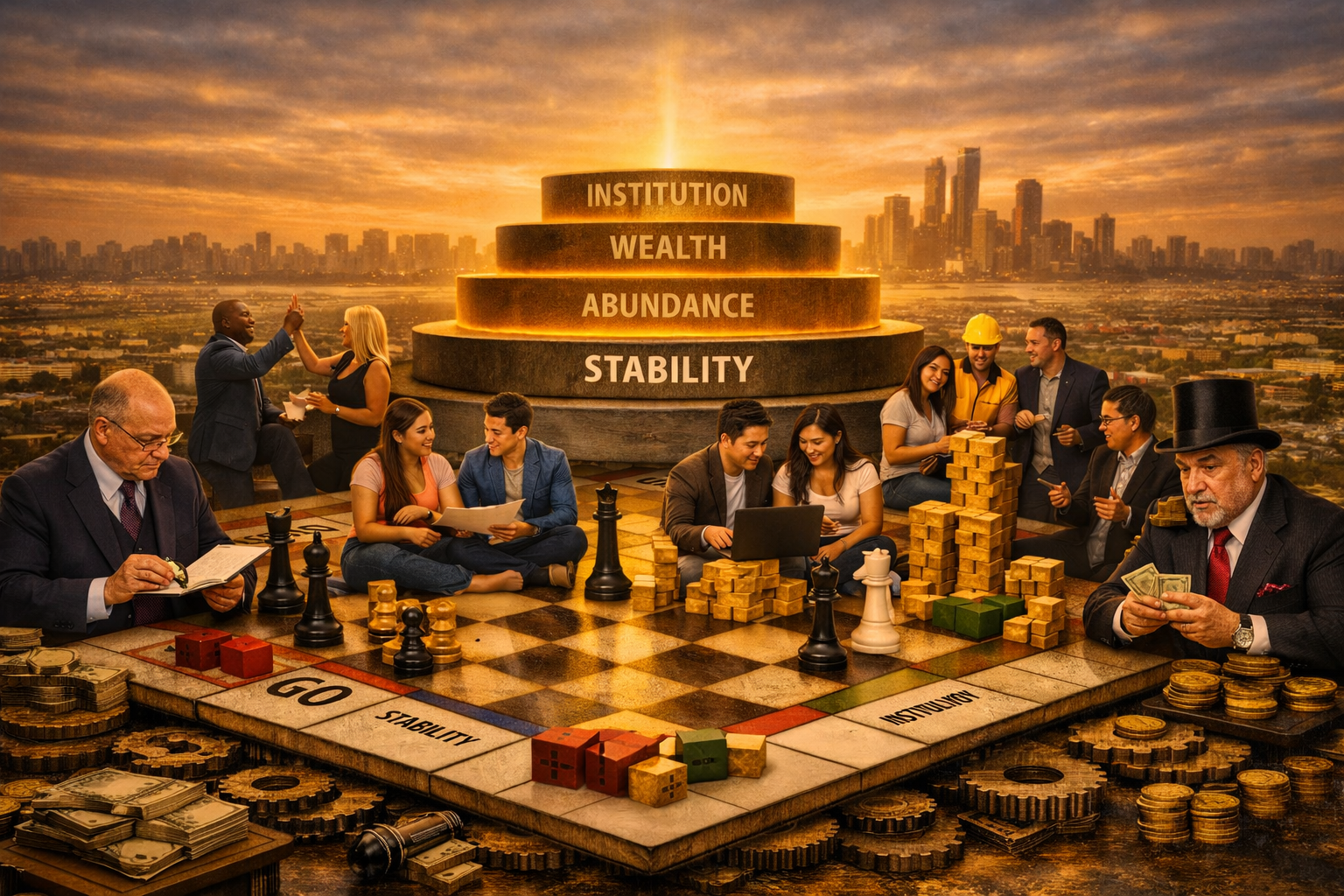
THE TENTH EXPANSION: STABILITY → ABUNDANCE → WEALTH → INSTITUTION
Abundance appears first:
- time Stability frees hours you didn’t know you were losing.
- energy Stability frees capacity you forgot you had.
- clarity Stability frees the mind from noise.
- operational breathing room Stability frees the system from chaos.
- financial predictability Stability frees the household from fear.
Then wealth emerges:
- resilience Wealth is the ability to absorb impact without collapsing.
- options Wealth is the ability to choose instead of react.
- continuity Wealth is the ability to sustain progress.
- protection Wealth is the ability to shield what matters.
- legacy Wealth is the ability to outlive yourself.
And when wealth compounds long enough, it becomes:
Institution. Not a building. Not a corporation. Not a brand. A structure that outlives the person who built it.
Institution as:
a business with rhythm – Rhythm is the heartbeat of stability.
a team with clarity – Clarity is the language of stability.
a culture with structure – Structure is the backbone of stability.
a leadership model that outlives the leader – Leadership is the identity of stability.
a system that becomes bigger than the founder – System is the engine of stability.
an exit that preserves everything built – Continuity is the legacy of stability.
This is the part where everything clicks:
Stability isn’t the end goal. Stability is the beginning.
Stability gives you abundance. Abundance gives you wealth. Wealth gives you institution. Institution gives you legacy. Legacy gives you continuity. Continuity gives you freedom.
This is true capitalism — not the engineered version that squeezes you, but the stabilized version that sustains you.
WHERE AP FITS IN
AP exists to help individuals, households, solopreneurs, business owners, nonprofit leaders, and enterprise executives build stability systems that scale.
AP’s doctrine is simple:
Stability first. Abundance next. Wealth last — because the foundation can finally hold it.
And the principle that guides everything — the one born in the trades, sharpened through public and private instruction, and proven across every client you’ve helped — is this:
Nothing is yours until you put your hand to it.
AP doesn’t build your life for you. AP builds it with you.
Because people keep what they help build — and they keep what they exit responsibly.
At AP, you are not a passenger. You are a partner.
A partner in your stability. A partner in your abundance. A partner in your wealth. A partner in your legacy. A partner in the institution you are becoming.
This is how stability becomes culture. This is how abundance becomes sustainable. This is how wealth becomes transferable. This is how legacy becomes inevitable.
THE FINAL DECISION POINT
Scroll slowly. This part is for the people who made it all the way here.
If you made it to this point — through every expansion, through every truth, through every mirror, through every diagnosis —
that tells me something about you.
It tells me you feel seen. It tells me you felt understood. It tells me you recognized the engineered instability. It tells me you recognized yourself in the architecture. It tells me you recognized the patterns you’ve been living inside. It tells me you recognized the pressure you’ve been carrying alone. It tells me you recognized the truth you’ve been avoiding. It tells me you recognized the cost of staying where you are. It tells me you recognized the possibility of something different.
And most importantly:
It tells me you’re ready to do something about it.
Because people who aren’t ready don’t make it this far. People who aren’t ready stop at the first mirror. People who aren’t ready stop at the first truth. People who aren’t ready stop at the first discomfort.
But you didn’t stop. You kept going. You kept reading. You kept recognizing yourself. You kept confronting the architecture. You kept absorbing the doctrine. You kept moving toward stability.
And that means one thing:
You’re ready for the next step.
The next step is simple: Book your Diagnostic.
Stop trying to stabilize yourself alone. Start stabilizing yourself with a system. Start stabilizing yourself with a partner. Start stabilizing yourself with AP.
Because stability isn’t a dream. Stability isn’t a fantasy. Stability isn’t a luxury.
Stability is engineered. And it’s time to engineer yours.
The door is open.